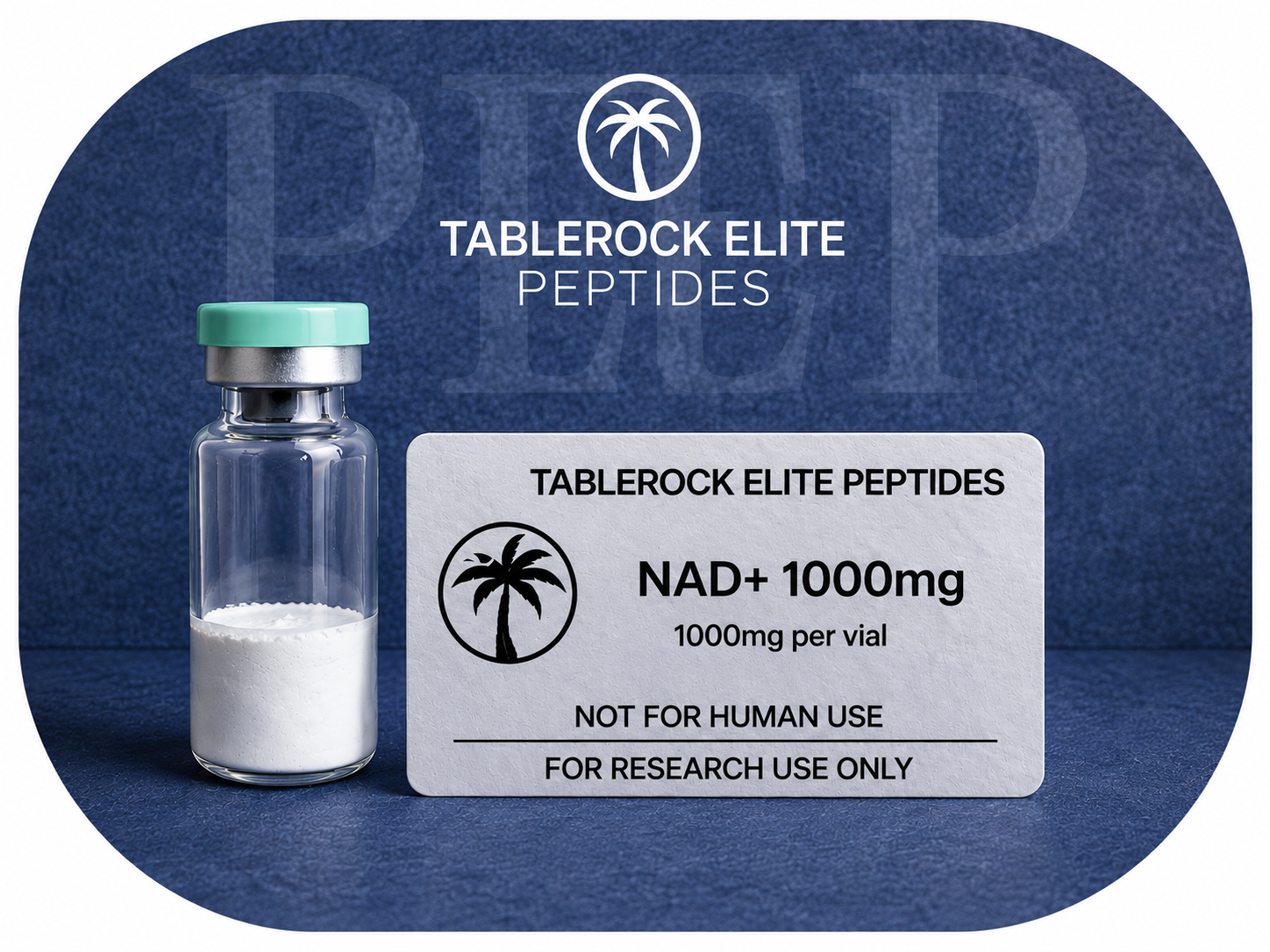
NAD+ – 1000 mg – Research Compound
$129.99
NAD+ 1000 mg – Research FAQ
Q: What is NAD+ 1000 mg?
A: NAD+ 1000 mg is Nicotinamide Adenine Dinucleotide, a naturally occurring dinucleotide coenzyme supplied as a dry research material for controlled laboratory and analytical investigation.
Each vial contains 1000 mg of NAD+ research material.
Q: Is NAD+ a peptide?
A: No. NAD+ is not a peptide. It is a nucleotide-derived biological coenzyme involved in numerous biochemical reactions and enzyme systems.
It is offered by Tablerock Elite Peptides as a laboratory research material rather than as a peptide.
Q: What is the relationship between NAD+ and NADH?
A: NAD+ is the oxidized form of a biological redox pair, while NADH is the corresponding reduced form.
The reversible relationship between NAD+ and NADH is important in electron-transfer reactions and numerous metabolic processes. Researchers may measure or experimentally manipulate the NAD+/NADH relationship when investigating cellular and biochemical systems.
Q: What areas of research involve NAD+?
A: NAD+ is widely investigated in experimental research involving cellular metabolism, oxidation-reduction reactions, NAD+/NADH redox biology, mitochondrial-associated metabolism, enzyme activity, sirtuin-associated pathways, PARP-associated pathways, and intracellular signaling.
These areas describe biochemical research applications and should not be interpreted as established clinical or therapeutic effects.
Q: Why is NAD+ used in sirtuin research?
A: Sirtuins are a family of NAD+-dependent enzymes. Because their enzymatic activity involves NAD+, researchers may manipulate or measure NAD+ availability when investigating sirtuin-associated molecular pathways.
Changes observed in enzyme activity or experimental biomarkers do not by themselves establish a clinical effect.
Q: Why is NAD+ associated with PARP research?
A: Poly(ADP-ribose) polymerases (PARPs) are enzymes involved in ADP-ribosylation and other cellular molecular processes.
NAD+ serves as a substrate in PARP-associated enzymatic reactions, making it relevant to experimental investigation of enzyme activity, ADP-ribosylation, molecular signaling, and cellular responses associated with DNA integrity.
Q: Why is NAD+ investigated in mitochondrial research?
A: NAD+/NADH-dependent reactions participate in numerous metabolic processes associated with cellular and mitochondrial biology.
Researchers may examine NAD+ and NADH when investigating metabolic pathways, redox conditions, mitochondrial-associated metabolism, and biochemical responses to changes in cellular metabolic state.
This research context does not establish that NAD+ 1000 mg sold by Tablerock Elite Peptides produces any particular physiological or therapeutic outcome.
Q: Are findings from NAD+ research considered established clinical effects?
A: No. Results obtained from biochemical, cellular, animal, or other experimental models must be interpreted within the methodology and limitations of the individual study.
Research involving metabolic pathways, enzymes, molecular markers, or experimental models does not establish that this research material is safe, effective, or suitable for human or veterinary use.
Q: Is NAD+ 1000 mg sold by Tablerock an approved pharmaceutical product?
A: No. NAD+ 1000 mg sold by Tablerock Elite Peptides is supplied solely as a laboratory research material. It is not manufactured, labeled, or supplied as a prescription drug, compounded medication, dietary supplement, cosmetic, food product, or other finished pharmaceutical or consumer product.
Q: How should NAD+ 1000 mg research material be stored?
A: Dry NAD+ research material should generally be maintained tightly sealed and protected from moisture, unnecessary light, and heat according to applicable product documentation and laboratory procedures.
Prepared laboratory solutions should be handled according to the applicable experimental protocol and institutional standard operating procedures. Factors such as temperature, pH, concentration, and storage duration may affect experimental handling requirements.
Q: Does Tablerock provide dosing or administration instructions for NAD+ 1000 mg?
A: No. Tablerock Elite Peptides does not provide or endorse human or veterinary dosing, administration, injection, infusion, ingestion, topical application, treatment protocols, preparation-for-human-use instructions, or self-administration guidance for NAD+.
Q: Is NAD+ 1000 mg intended for human or veterinary use?
A: No. NAD+ 1000 mg is supplied strictly for laboratory research use only. It must not be used for human or animal injection, infusion, ingestion, consumption, topical application, self-administration, diagnosis, treatment, cure, mitigation, prevention, or any other clinical, cosmetic, or therapeutic purpose.
Research Use Only. Not for Human or Veterinary Use.
9 in stock
Description
NAD+ 1000 mg – Research Compound
Overview
NAD+ 1000 mg (Nicotinamide Adenine Dinucleotide) is supplied as a dry research material for controlled laboratory and analytical investigation.
NAD+ is a naturally occurring dinucleotide coenzyme found throughout living cells. It participates in fundamental biochemical processes involving oxidation-reduction reactions, cellular metabolism, enzyme activity, mitochondrial-associated metabolism, and intracellular signaling.
NAD+ exists in an oxidized/reduced relationship with NADH, and the NAD+/NADH system is widely investigated in biochemical and cellular research involving metabolic and redox processes.
NAD+ also serves as a required substrate or cofactor for multiple enzyme systems, including sirtuins and poly(ADP-ribose) polymerases (PARPs).
Material Information
- Research material: NAD+
- Chemical name: Nicotinamide Adenine Dinucleotide
- Quantity: 1000 mg
- Biochemical form: Oxidized NAD+
- Classification: Dinucleotide coenzyme
- Form: Dry research material
- Container: Single sealed research vial
- Intended use: Laboratory research use only
NAD+ is not a peptide. It is a nucleotide-derived biological coenzyme used extensively as an experimental material in biochemical, enzymatic, and cellular research.
Researchers should refer to the product label and applicable batch-specific analytical documentation when evaluating material identity, quantity, purity, and other characteristics.
What Is NAD+?
Nicotinamide Adenine Dinucleotide is a coenzyme involved in numerous biochemical reactions.
One of its fundamental research characteristics is its reversible relationship with its reduced form, NADH. Together, NAD+ and NADH constitute an important biological redox couple involved in electron-transfer reactions and cellular metabolic processes.
The relative abundance of NAD+ and NADH may be investigated as part of studies examining cellular or compartment-specific redox conditions.
Research Characteristics
Experimental research involving NAD+ may examine:
- NAD+/NADH redox relationships;
- Cellular oxidation-reduction reactions;
- Metabolic pathways;
- Mitochondrial-associated metabolism;
- NAD+-dependent enzyme activity;
- Sirtuin-associated molecular pathways;
- PARP-associated pathways;
- ADP-ribosylation;
- Cellular responses associated with changes in metabolic state; and
- Comparative biochemical and enzymatic activity.
These areas describe subjects of biochemical investigation and do not represent established clinical or therapeutic effects of the research material sold by Tablerock Elite Peptides.
Sirtuin-Associated Research
Sirtuins are a family of NAD+-dependent enzymes investigated in numerous areas of molecular and cellular biology.
Because NAD+ participates in sirtuin-associated enzymatic reactions, researchers may manipulate or measure NAD+ availability when investigating sirtuin activity, associated signaling pathways, and downstream molecular responses.
The observation of changes in enzyme activity or experimental biomarkers does not by itself establish a clinical effect.
PARP-Associated Research
Poly(ADP-ribose) polymerases (PARPs) are enzymes involved in ADP-ribosylation and other cellular molecular processes.
NAD+ serves as a substrate for PARP-associated enzymatic reactions, making it relevant to experimental systems examining enzyme activity, ADP-ribosylation, and cellular responses associated with DNA integrity and molecular signaling.
Laboratory Research Applications
NAD+ may be investigated in controlled experimental systems involving:
- Cellular metabolism: Investigation of NAD+-dependent oxidation-reduction reactions and associated metabolic pathways.
- Redox biology: Measurement and experimental manipulation of NAD+/NADH relationships.
- Mitochondrial research: Investigation of mitochondrial-associated metabolism and cellular metabolic states.
- Enzyme research: Use as a substrate or cofactor in defined NAD+-dependent enzymatic assays.
- Sirtuin research: Investigation of NAD+-dependent enzyme activity and associated molecular pathways.
- PARP research: Investigation of NAD+-dependent ADP-ribosylation and related molecular processes.
- Biochemical research: Examination of NAD+-dependent reactions under defined experimental conditions.
- Analytical research: Characterization of material identity, purity, stability, and related properties.
Experimental design, concentrations, controls, endpoints, and interpretation of findings are determined by the individual laboratory or research protocol.
Handling and Storage
NAD+ research material should be handled according to applicable institutional procedures, product documentation, and established laboratory practices.
The dry material should generally be maintained:
- Tightly sealed and protected from moisture;
- Protected from unnecessary exposure to light and heat;
- Under storage conditions appropriate to the material and applicable product documentation; and
- In a manner that minimizes unnecessary environmental or temperature fluctuations.
Prepared laboratory solutions should be handled according to the applicable experimental protocol and institutional standard operating procedures.
Researchers should consider factors including temperature, pH, concentration, and storage duration when establishing validated handling procedures for prepared NAD+ solutions.
Appropriate laboratory PPE, chemical-hygiene procedures, and disposal requirements should be followed.
Technical Summary
| Parameter | Details |
|---|---|
| Product | NAD+ 1000 mg |
| Chemical name | Nicotinamide Adenine Dinucleotide |
| Quantity | 1000 mg |
| Biochemical form | Oxidized NAD+ |
| Classification | Dinucleotide coenzyme |
| Form | Dry research material |
| Research focus | NAD+/NADH redox biology, cellular metabolism, mitochondrial-associated metabolism, sirtuin activity, PARP activity, and enzyme systems |
| Intended use | Laboratory research use only |
| Human/veterinary use | Not intended for human or veterinary use |
No Dosing or Administration Guidance
Tablerock Elite Peptides does not provide or endorse human or veterinary dosing, administration, injection, infusion, ingestion, topical application, treatment protocols, preparation-for-human-use instructions, or self-administration guidance for NAD+ 1000 mg.
Research Use Only
NAD+ 1000 mg sold by Tablerock Elite Peptides is supplied exclusively for laboratory research use.
It is not supplied as a prescription drug, compounded medication, dietary supplement, cosmetic, food product, or other finished pharmaceutical or consumer product and is not intended for human or veterinary use.
It must not be used for human or animal injection, infusion, ingestion, consumption, topical application, self-administration, diagnosis, treatment, cure, mitigation, prevention, or any other clinical, cosmetic, or therapeutic purpose.
Research Use Only. Not for Human or Veterinary Use.
Disclaimer: For laboratory research use only. This product is not intended for human consumption, injection, or ingestion.
Reviews
There are no reviews yet.