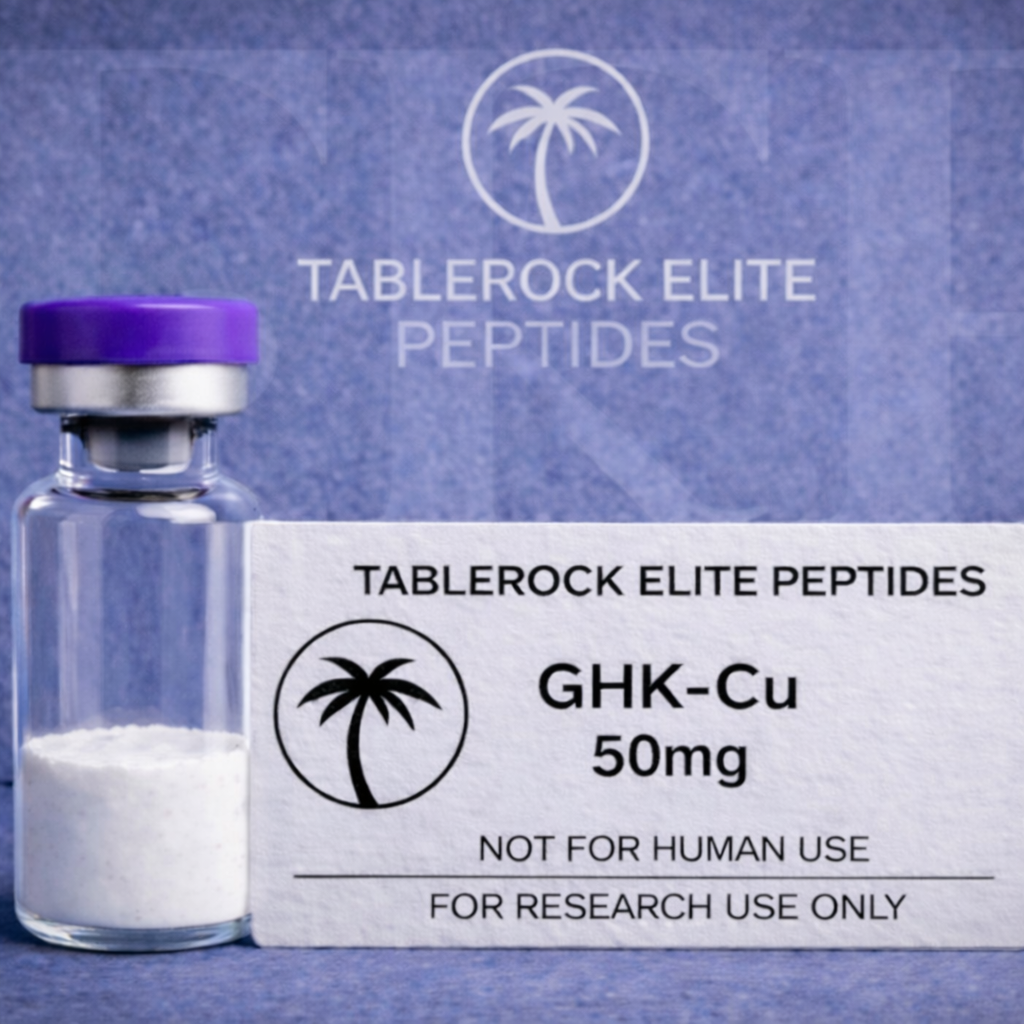
GHK‑Cu 50mg – Research Peptide
$15.99
GHK-Cu 50 mg – Research FAQ
Q: What is GHK-Cu 50 mg?
A: GHK-Cu is a copper-binding tripeptide consisting of the amino-acid sequence glycyl-L-histidyl-L-lysine (GHK) complexed with copper ions. This product is supplied as 50 mg of lyophilized research material for controlled laboratory investigation.
Q: What aspects of GHK-Cu are studied in research?
A: Experimental research involving GHK-Cu has examined copper-binding activity, cellular signaling, gene-expression patterns, extracellular-matrix biology, fibroblast activity, and molecular pathways associated with cellular and tissue-level responses.
The available evidence includes different experimental models and levels of scientific evidence. Findings should therefore be interpreted within the methodology, design, and limitations of each individual study and should not be interpreted as established clinical or cosmetic effects.
Q: What does “copper-binding peptide” mean?
A: A copper-binding peptide is a peptide capable of forming a molecular complex with copper ions. In GHK-Cu, the GHK peptide coordinates copper through interactions involving its amino-acid structure.
Copper participates in numerous biological and biochemical processes, making peptide-copper interactions an area of interest in molecular, cellular, and biochemical research.
Q: What is the extracellular matrix and why is it studied?
A: The extracellular matrix (ECM) is the network of proteins and other molecules surrounding cells that contributes to cellular structure, organization, communication, and signaling.
Researchers study GHK-Cu in experimental systems involving ECM-associated biology to investigate relationships among peptide signaling, cellular responses, gene expression, and matrix-associated processes.
Q: What are fibroblasts?
A: Fibroblasts are cells found in connective tissues that participate in the production and organization of components of the extracellular matrix.
Because fibroblasts play an important role in extracellular-matrix biology, they are frequently used in laboratory models investigating cellular signaling and matrix-associated molecular processes.
Q: How should lyophilized GHK-Cu research material be stored?
A: Laboratory storage and handling should follow applicable institutional procedures, supplier documentation, and established laboratory practices for peptide research materials. Researchers should minimize unnecessary exposure to heat, light, moisture, and repeated temperature changes that could affect material integrity.
Q: Does Tablerock provide cosmetic, human dosing, administration, or treatment guidance for GHK-Cu 50 mg?
A: No. Tablerock Elite Peptides does not provide topical application, dosing, injection, treatment, cosmetic-use, therapeutic protocols, or self-administration instructions for this research material.
Q: Is GHK-Cu 50 mg intended for human or veterinary use?
A: No. GHK-Cu 50 mg is sold strictly for laboratory research purposes. It is not intended for human or veterinary administration, consumption, topical cosmetic application, diagnosis, treatment, prevention, or other clinical use.
Research Use Only. Not for Human or Veterinary Use.
Batch Documentation
Current batch COA: View GHK-Cu 50 mg COA
Batch-specific analytical documentation for this product is also available through the Tablerock Elite Peptides Certificates of Analysis (COA) Library.
28 in stock
Description
GHK-Cu 50 mg – Research Peptide
Overview
GHK-Cu 50 mg is a synthetic copper-binding tripeptide supplied as a lyophilized research material for controlled laboratory and analytical investigation.
GHK-Cu consists of the peptide sequence glycyl-L-histidyl-L-lysine (GHK) complexed with copper(II). It is investigated in experimental systems involving copper-peptide interactions, cellular signaling, extracellular matrix biology, gene-expression pathways, and related molecular processes.
Research findings involving GHK-Cu vary according to experimental model, methodology, and study design and should be interpreted within the limitations of the individual study.
Material Information
- Research material: GHK-Cu
- Alternative designation: Copper tripeptide-1
- Quantity: 50 mg
- Form: Lyophilized research material
- Peptide sequence: Glycyl-L-histidyl-L-lysine
- Complex: Copper(II)-bound GHK
- Container: Single sealed research vial
- Intended use: Laboratory research use only
Researchers should refer to the product label and applicable batch-specific analytical documentation when evaluating material identity, quantity, purity, and other characteristics.
What Is GHK-Cu?
GHK is a three-amino-acid peptide composed of glycine, histidine, and lysine. GHK is capable of binding copper ions, producing the copper-peptide complex commonly referred to as GHK-Cu.
This copper-binding characteristic has made GHK-Cu a subject of experimental investigation involving metal-peptide interactions, molecular signaling, cellular processes, extracellular matrix biology, and gene-expression-associated pathways.
Research Characteristics
Experimental research involving GHK-Cu may examine:
- Copper-peptide binding and coordination;
- Cellular signaling pathways;
- Extracellular matrix-associated biology;
- Gene-expression responses;
- Cell-migration mechanisms;
- Oxidative and redox-associated pathways;
- Inflammatory signaling pathways;
- Molecular interactions involving extracellular proteins; and
- Comparative activity of copper-bound and unbound peptide systems.
The presence of a pathway, mechanism, marker, or experimental response in published research does not establish safety, effectiveness, or suitability for human or veterinary use.
Laboratory Research Applications
GHK-Cu may be investigated in controlled experimental models involving:
- Copper-binding research: Investigation of interactions between GHK and copper ions.
- Cellular signaling: Examination of molecular pathways associated with exposure to the copper-peptide complex.
- Extracellular matrix research: Investigation of signaling and molecular processes associated with extracellular matrix components.
- Gene-expression research: Examination of changes in gene-expression patterns under defined experimental conditions.
- Cell-biology research: Investigation of cellular responses, migration, and related molecular mechanisms.
- Comparative peptide research: Comparison of GHK-Cu with GHK or other peptide research materials.
- Analytical research: Characterization of material identity, purity, stability, and related properties.
Experimental design, concentrations, controls, endpoints, and interpretation of findings are determined by the individual laboratory or research protocol.
Handling and Storage
GHK-Cu research material should be handled according to applicable institutional procedures, product documentation, and established laboratory practices for peptide research materials.
The lyophilized material should generally be maintained:
- Sealed and protected from moisture;
- Protected from unnecessary exposure to light and heat;
- Under appropriate refrigerated or frozen laboratory storage conditions; and
- In a manner that minimizes unnecessary temperature fluctuations.
Prepared laboratory solutions should be handled according to the applicable experimental protocol and institutional standard operating procedures. Repeated freeze-thaw cycles should be minimized where appropriate.
Appropriate laboratory PPE, aseptic practices, chemical-hygiene procedures, and disposal requirements should be followed.
Technical Summary
| Parameter | Details |
|---|---|
| Product | GHK-Cu 50 mg |
| Research designation | Copper tripeptide-1 |
| Peptide sequence | Glycyl-L-histidyl-L-lysine |
| Complex | Copper(II)-bound GHK |
| Quantity | 50 mg |
| Form | Lyophilized research material |
| Research focus | Copper-peptide interactions, cellular signaling, extracellular matrix biology, gene-expression pathways |
| Intended use | Laboratory research use only |
| Human/veterinary use | Not intended for human or veterinary use |
No Cosmetic, Dosing, or Administration Guidance
Tablerock Elite Peptides does not provide or endorse human or veterinary dosing, administration, injection, topical application, cosmetic-use instructions, treatment protocols, reconstitution-for-human-use instructions, or self-administration guidance for GHK-Cu 50 mg.
Research Use Only
This GHK-Cu 50 mg research material is supplied exclusively for laboratory research use.
It is not supplied as a prescription drug, compounded medication, dietary supplement, cosmetic, or other finished pharmaceutical product and is not intended for human or veterinary use.
It must not be used for human or animal injection, ingestion, consumption, topical application, self-administration, diagnosis, treatment, cure, mitigation, prevention, cosmetic use, or any other clinical or therapeutic purpose.
Research Use Only. Not for Human or Veterinary Use.
Disclaimer: For laboratory research use only. This product is not intended for human consumption, injection, or ingestion.
Reviews
There are no reviews yet.